We believe that strong teams are not built through generic workshops or one-size-fits-all leadership models. They are built by understanding how people think, communicate, process information, respond to pressure, and collaborate with others.
Our corporate learning services are designed to help organizations strengthen communication, improve workplace culture, develop leaders, and build high-performing teams through practical, psychology-informed learning experiences.

Corporate Learning Strategy
Traditional team-building activities often focus on temporary engagement.
Our approach focuses on sustainable team development by helping employees understand the thinking patterns, strengths, and stress responses of the people they work with every day.
Participants leave with practical tools that improve communication, reduce misunderstandings, and create stronger collaboration across teams.
Executive Thinking Profile team assessments
Team communication workshops
Conflict resolution and collaboration training
Workplace relationship mapping
Psychological safety and trust-building initiatives
Cross-department communication strategies
Interactive problem-solving simulations
Team dynamics and role-awareness sessions
Change management and adaptability training
Workplace culture development sessions
Team Building & Workplace Culture


Our leadership training programs are designed for:
Emerging leaders
Supervisors and managers
Executive teams
Project leads
Human resource professionals
Educators and trainers within organizations
Available leadership training topics include:
Adaptive leadership strategies
Communication across thinking styles
Emotional intelligence in leadership
Coaching and feedback strategies
Leading diverse teams
Conflict management
Decision-making under pressure
Employee motivation and engagement
Inclusive leadership practices
Building accountability and team ownership
Strategic thinking and problem-solving
Facilitation and presentation skills
Leadership Development & Training
Modern leadership requires more than operational knowledge. Effective leaders must understand motivation, communication, emotional regulation, learning differences, and team dynamics in increasingly complex workplaces.


The Learning Profiles
Learning profiles, or executive thinking types, are natural ways individuals process information, make sense of ideas, and approach learning tasks.
Rather than focusing on what someone knows, they focus on how someone thinks. Each profile reflects patterns in cognition such as organizing visually, processing sequentially, connecting through meaning, learning by doing, reflecting deeply, synthesizing ideas, or reasoning through language.
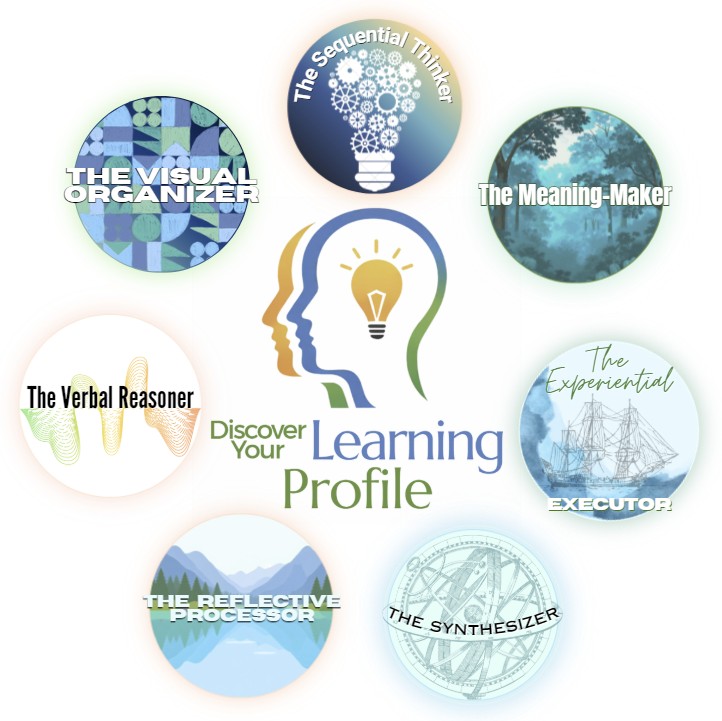
Learning is not one-size-fits-all. When educators and learners uncover how comprehension looks different for each individual, they can align strategies, instruction, and assessment in ways that reduce frustration and increase clarity. This leads to stronger engagement, more meaningful feedback, and improved performance.
Finding out your Learning Profile can have some great outcomes:
Helps learners understand how they think, not just what they know
Increases confidence by validating different ways of learning
Supports more effective, personalized study strategies
Strengthens metacognition and self-awareness
Reduces frustration, anxiety, and cognitive overload
Promotes deeper understanding rather than surface-level memorization
Helps learners advocate for their learning needs
Improves ability to collaborate by understanding how others think
Leads to more efficient and effective learning overall